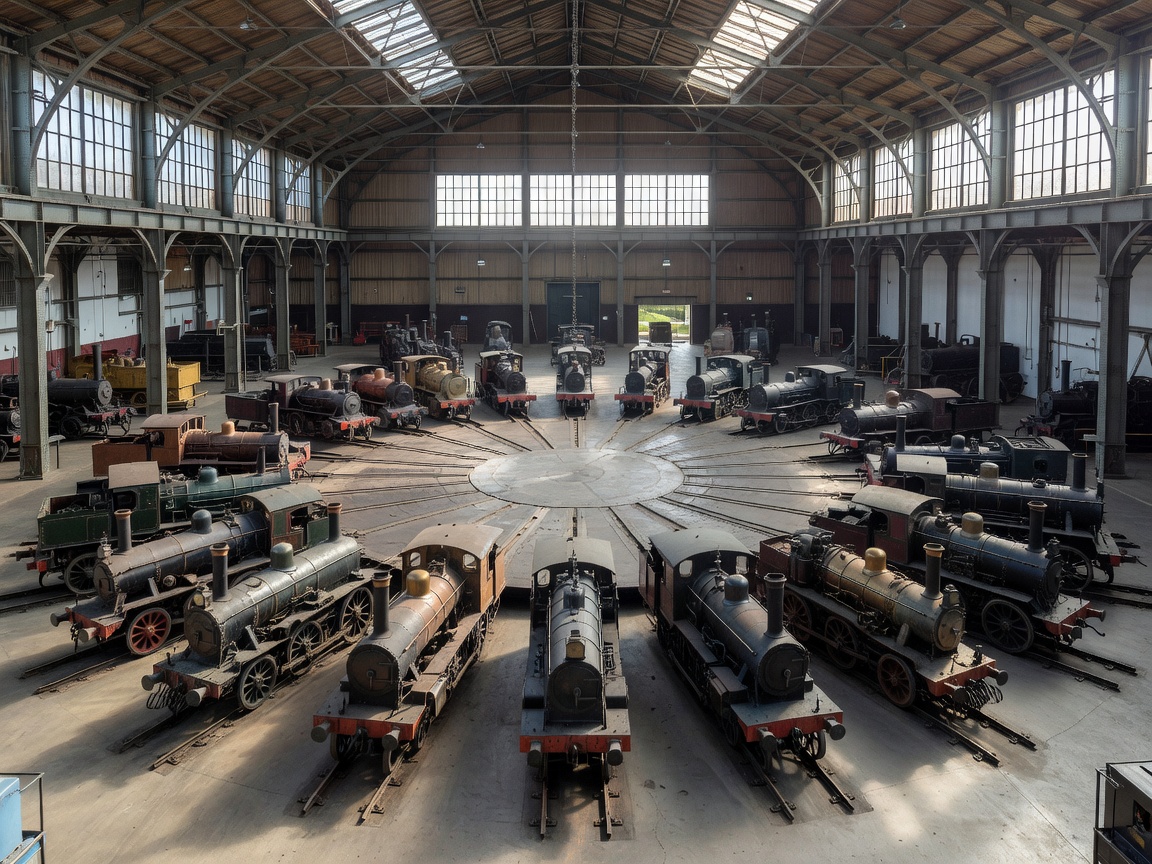
Sanctuaries of Steam: The Architecture of the Roundhouse
Across Europe, the most compelling railway museums are housed within the very buildings constructed to service locomotives during their operational lives. The circular or semi-circular roundhouse (known as the Rotonde in France and Ringlokschuppen in Germany) was an architectural marvel of efficiency. Locomotives entered onto a central balanced turntable that rotated to align with dozens of radiating inspection pits under sheltering brick bays.
Visiting institutions such as the National Railway Museum in York, the Cité du Train in Mulhouse, France, or the DB Museum in Nuremberg reveals how these functional industrial spaces have been reimagined as world-class cultural institutions. In a preserved roundhouse, visitors do not merely observe isolated exhibits; they experience the communal spatial logic of rail yards, complete with overhead smoke troughs, drop pits for axle replacement, and gantry cranes.
Static Conservation Science
While dynamic heritage lines draw public excitement, national railway museums perform an essential scientific mission: non-destructive static preservation. When an operational locomotive runs, heat, coal sulphur, vibrations, and water mineral deposits inevitably wear away original materials. Museum conservators prioritize stabilisation over alteration, guided by strict international preservation standards.
Inside controlled museum environments, conservators address specific degradation vectors:
- Microclimatic Humidity Control: Fluctuations in relative humidity accelerate ferrous corrosion on boiler jackets and rot wooden sub-frames. Major museums maintain exhibition halls between 45% and 55% relative humidity to prevent flash rusting on bare polished steel rods.
- Preservation of Original Paint Layers: Rather than stripping machinery down to bare metal and repainting with modern polyurethane coatings, museum conservators analyse original paint strata using microscopic cross-section analysis. Historic varnishes and coach enamels are stabilised using conservation-grade microcrystalline waxes.
- Asbestos Remediation: Most mid-20th-century locomotives utilised asbestos blankets for boiler lagging. Safe public exhibition requires delicate encapsulation or licensed abatement while preserving the original sheet metal wrapper dimensions.
Interactive Interpretation: The Working Workshop
Modern railway curation has moved far beyond passive display placards. Modern facilities, such as the open workshops at York and Mulhouse, feature glass viewing galleries overlooking active restoration pits. Visitors watch machinists turn driving-wheel tyres on 19th-century wheel lathes, witness boilermakers replace stays, and see coach trimmers stitch horsehair cushions, turning conservation into an active educational theatre.
Curating the Human Dimension of European Rail
A true railway museum does not stop at heavy steel. The most poignant exhibits in Europe's collections document the lived experiences of railway workers and travelers. Signaling instruments, brass token keys, station clocks synchronized by telegraph pulse, and porcelain dining services from trans-European expresses illuminate how railways regulated everyday society.
From the uniforms of French cheminots to the intricate hand-drawn route maps of the Austro-Hungarian railway network, museums capture the social bonds that connected rail communities. Small, regional railway museums across Sweden, Belgium, Poland, and Spain preserve regional industrial identities, ensuring that local mining lines and agricultural narrow-gauge routes are not forgotten amidst celebrated national high-speed achievements.
Visiting Railway Museums: Key Considerations
When planning visits to Europe's major collections, we recommend timing trips around designated "steaming days" or heritage galas. While main halls offer contemplative study of static engines, open-air roundhouse events bring selected yard shunting locomotives to life, demonstrating turntable movements and the unmistakable acoustic resonance of working steam injectors.