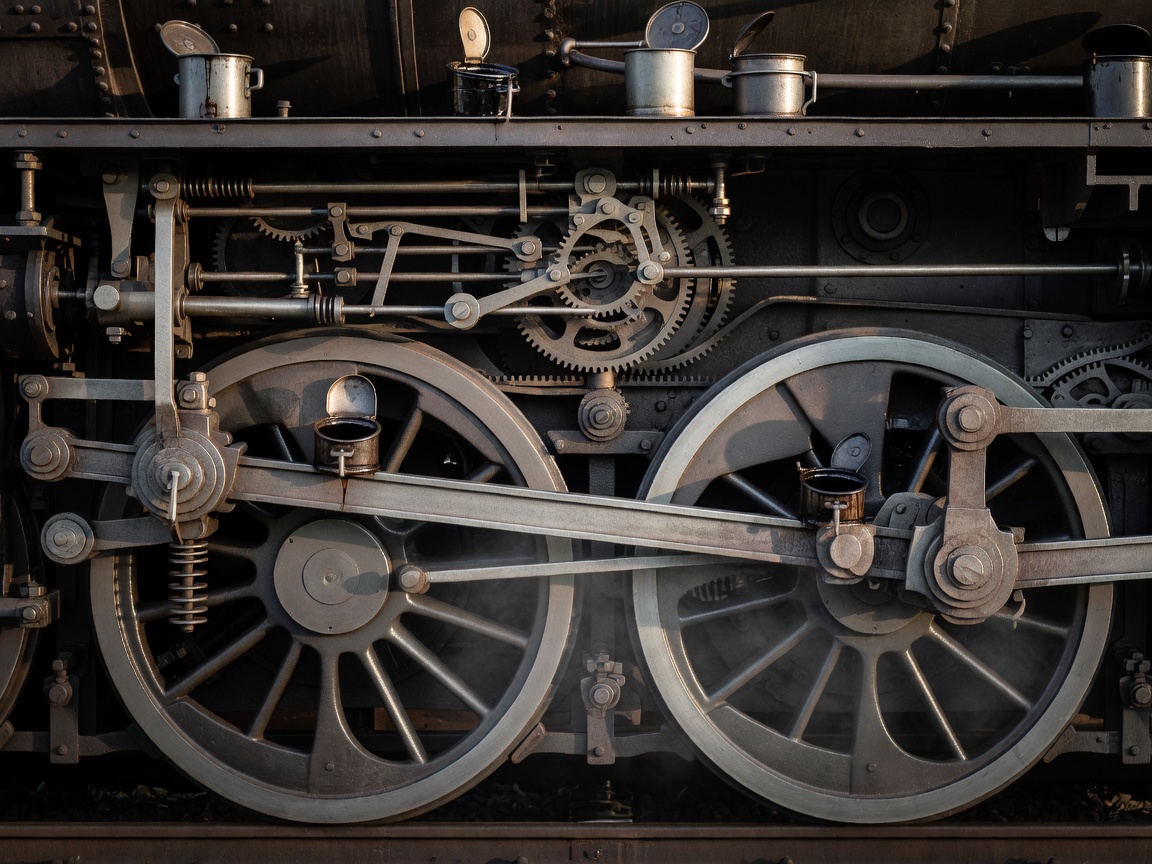
The Mechanical Heart: Thermodynamics on Steel Wheels
When we examine a historic steam locomotive, we are not looking at an inert museum piece, but rather a self-contained thermodynamic power plant operating under intense thermal and mechanical stress. The European steam locomotive evolved along distinctive national design philosophies, yet they all shared the fundamental triumph of balancing steam generation in the boiler with precise steam expansion in reciprocating double-acting cylinders.
Central to European efficiency was the mastery of valve gear. While early British designers favoured Stephenson link motion housed between the frames, continental European engineers largely adopted external Walschaerts valve gear (invented by the Belgian engineer Egide Walschaerts in 1844). Walschaerts gear provided excellent steam distribution, allowed easy visual inspection of pins and eccentric cranks without crawling beneath the engine, and simplified depot maintenance. On high-speed express designs, such as the famous French Chapelon Pacifics or German Class 01 two-cylinder engines, precise valve events allowed cut-offs as low as 15% at cruising speeds, extracting every calorie of energy from superheated steam before exhaust.
Boiler Anatomy and Superheating Advances
At the core of locomotive preservation lies the steel or copper boiler. Pressures in historic European express locomotives ranged from 160 pounds per square inch (psi) in early designs up to 250 psi in late-era Pacifics. The firebox, suspended inside the boiler wrapper by hundreds of copper or steel stays, had to transfer heat from a glowing coal fire bed to thousands of litres of surrounding water.
The introduction of the Schmidt superheater in the early 20th century transformed European locomotive capability. By redirecting saturated steam from the regulator back through large flue tubes exposed to hot combustion gases, steam temperatures were elevated from roughly 190°C to upwards of 350°C. This prevented cylinder condensation, reduced coal consumption by up to 20%, and delivered the dry, elastic steam needed to sustain sustained runs over 130 km/h on main-line routes.
The Preservationist's Challenge: Ten-Year Boiler Inspections
Boiler preservation is the most financially and technically demanding aspect of operating historic locomotives. European regulatory codes require locomotives to undergo thorough internal inspections at ten-year intervals. This requires lifting the boiler completely from the locomotive chassis, stripping away all lagging and cladding, removing every firetube, and having certified non-destructive testing technicians measure plate thickness with ultrasonic probes. Any wasted plate must be hot-riveted or certified-welded by specialists holding pressure vessel credentials.
The Leap to Electric & Diesel Heritage
European railway heritage encompasses far more than steam. Electrification began remarkably early in Europe, driven by coal scarcity in Switzerland and Italy and the necessity of clearing smoke from lengthy alpine tunnels. The Swiss Federal Railways (SBB) Ce 6/8 II "Crocodile" locomotives, built in the early 1920s, used side rods connected to massive slow-speed electric motors to conquer the steep 2.7% gradients of the Gotthard route. Preserving these early AC electric giants demands specialised electrical conservators who understand oil-cooled step-down transformers, rotary converters, and pneumatic pantograph linkages.
Similarly, post-war diesel hydraulic designs, such as the German DB Class V 200 with its unmistakable sculpted twin-cab aesthetic, demonstrated Western Germany's mastery of lightweight Maybach engines and Voith hydrodynamic transmissions. Heritage societies preserve these diesel and electric icons with equal devotion, recognizing that they shaped the modern post-war commuter and intercity era.
Operating vs. Static Preservation Dilemma
Curators and preservation teams constantly balance two competing philosophies:
- Dynamic Operational Preservation: Running locomotives on heritage tracks or the national network provides an incomparable sensory education — the sound of cylinder cocks opening, the rhythmic exhaust beat, and the aroma of hot cylinder oil. However, every mile steamed causes metal loss on tyres, pin wear on the motion, and thermal stress on firebox copper.
- Static Archival Conservation: Retaining historic locomotives in dry, controlled museum roundhouses protects their original metal, historic factory paint layers, and irreplaceable original components from irreversible fatigue.
Many European institutions now adopt a balanced lifecycle: locomotives run for a certified boiler ticket of ten to fifteen years before retiring to static exhibition, allowing a different engine from the reserve collection to undergo overhaul.